Ottoman Reupholstery Guide
Ottomans are a versatile upholstery job that ranges from the very simple (a square box ottoman with wrap-and-staple construction) to the fairly complex (a large tufted cocktail ottoman or a storage ottoman with a hinged lid and piping on every edge). Understanding the variation in ottoman types helps you quote accurately and produce results that meet customer expectations.
Types of Ottomans
Box ottomans are the most common type: a padded top, sometimes with padded sides as well. Simple construction. The main variables are whether the sides are padded or hard-sided, and whether there is a skirt or a finished edge.
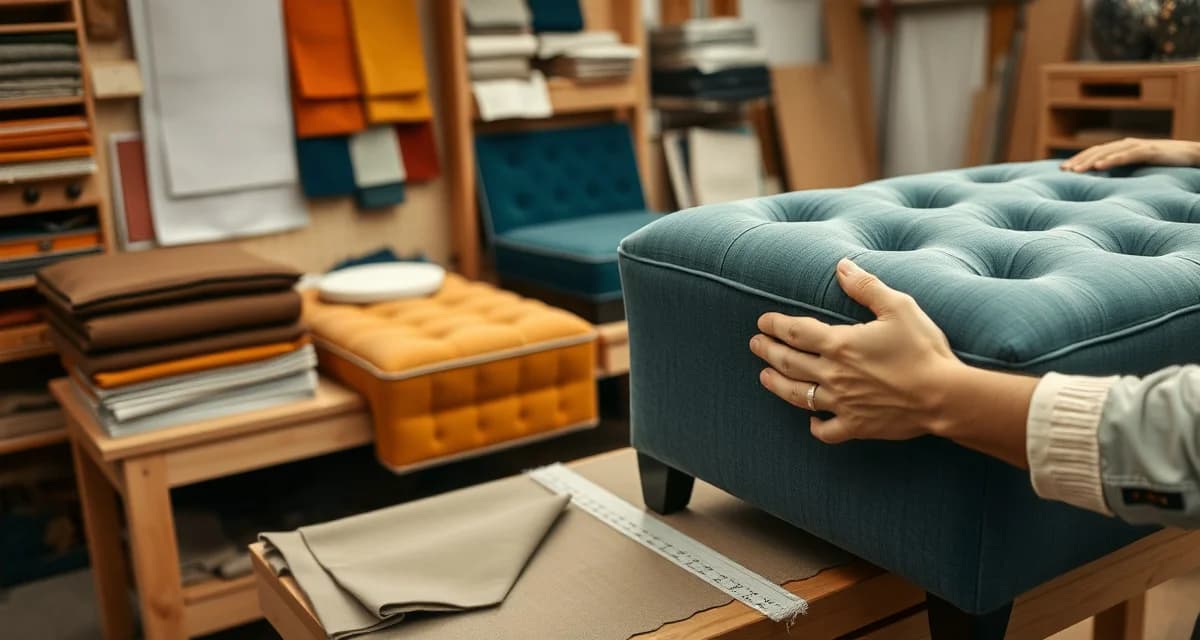
Tufted ottomans have a tufted top surface with through-foam button tufting. The tufting pattern is typically a diamond grid. The buttons must be spaced evenly and pulled to consistent depth.
Storage ottomans have a lid that lifts. The upholstery must not interfere with the hinge or the lid seal. Fabric at the hinge line must be tucked and trimmed to allow full lid movement.
Cocktail ottomans are large, low ottomans used in place of a coffee table. They may have a tray top insert or a hard leather top. The size makes yardage calculation more involved; some require seaming if the top face exceeds the fabric width.
Foot stools are small ottomans. Usually straightforward work, similar to bench reupholstery.
Fabric Selection for Ottomans
Ottomans used as seating or foot rests see heavy use. Feet placed on an ottoman, sitting on an ottoman, and the inevitable coffee cup or glass placed on the top surface all require a durable, cleanable fabric.
Recommended minimums:
- Performance fabric (Crypton, Revolution, or similar): ideal for high-use ottomans
- Leather or high-quality vinyl: excellent durability and cleanability for cocktail ottomans
- Plain weave polyester or poly-blend at 30,000+ double rubs: appropriate for moderate use
Velvet, boucle, and linen are not ideal choices for heavily used ottoman top surfaces. If a customer insists on a delicate fabric, note your recommendation of a more durable choice on the work order and get the customer's acknowledgment.
Fabric Yardage for Ottomans
Yardage depends on the ottoman dimensions and whether the sides are padded.
For a standard square box ottoman at 28 x 28 x 18 inches (a common cocktail ottoman size):
- Top face: 28 x 28 inches plus wrap = approximately 44 x 44 inches
- Four padded sides: each 28 x 18 inches plus seam allowances and wrap
- Total: approximately 4-5 yards for 54-inch fabric
For a simple foot stool at 18 x 18 x 12 inches:
- Total: approximately 1.5-2 yards
Tufted ottomans require extra yardage for the fabric pulled into the tufting grooves. Add 15-20% over the base top measurement.
For the fabric yardage calculator, enter the ottoman dimensions and specify the tufting if applicable.
Foam for Ottomans
Ottoman foam should be sized and specified for the use:
- Top cushion for seating use: 2.0-2.5 lb/ft3, ILD 35-45, 3-4 inches thick
- Top cushion for foot rest use: 2.0 lb/ft3, ILD 30-35, 3-4 inches thick
- Top cushion for decorative display: 1.5-1.8 lb/ft3, ILD 28-35, 2-3 inches thick
- Side padding: 1/2 to 1 inch thick low-density foam or polyester batting is typically sufficient for purely decorative padded sides
Wrap the top foam in Dacron batting before covering. For a tufted ottoman, choose foam at the firmer end of the ILD range (40-45 ILD) to hold tufting definition.
Corner Techniques
Box ottomans have four corners that require careful fabric handling. The options are:
Hospital corners: the fabric is folded and stapled at each corner in a folded pleat, similar to how hospital sheets are folded at bed corners. Clean and simple for fabric without a large pattern.
Mitered corners: the fabric is cut diagonally at each corner so the corner is sewn before installation. Produces a very clean, tailored corner. Takes longer but looks best on formal pieces.
Welted corners: a welt cord is sewn around the edges, and the corner is finished with the welt. The most formal look, appropriate for pieces with welt on all edges.
Choose the corner technique appropriate to the piece style and customer expectation. Note your choice on the work order.
Tufted Ottoman Process
- Mark the button grid on the foam with a marker. Typical grid spacing: 5-6 inch diamonds.
- Transfer the same grid to the fabric with chalk marks on the reverse, offsetting for the fabric that will pull into the grooves.
- Apply Dacron batting over the foam.
- Center the fabric over the ottoman.
- Pull the first button in the center through with the tufting needle, pulling snugly but not compressing the surface.
- Work outward from center, maintaining consistent button depth.
- Wrap and staple the edges after all tufting is complete.
See the upholstery shop spring repair guide if the ottoman has a webbing or spring base that needs assessment. For quoting, use StitchDesk to build itemized quotes showing foam, fabric, and labor for each ottoman component.