Chair Reupholstery Guide
Chairs are the bread and butter of most upholstery shops. They come in more variety than any other furniture category, from dining chairs with simple seat pads to fully upholstered wingbacks with welted seams on every edge. A systematic approach to chair reupholstery produces consistent results regardless of the chair type.
Assessing the Chair Before Quoting
Before any price discussion, inspect the frame. Chairs take a lot of stress at the leg joints and the corner blocks that hold the seat rail together. Press on the seat rail corners and test the legs with lateral pressure. Any movement or creaking indicates loose joints that need regluing before upholstery work begins.
Check the seat web or spring base. Older chairs with jute webbing should have webbing that is still under tension. Sagging webbing is a sign it needs replacement. The cost of webbing replacement is modest and the labor is straightforward, but it must be in the quote.
Inspect the existing foam if the chair has cushion-style seating. Compressed, crumbled, or discolored foam needs replacement. Trying to work around old foam is false economy: the customer will be dissatisfied with the result.
Document your inspection with photographs before any disassembly.
Fabric Yardage by Chair Type
Yardage varies substantially by chair construction. These are estimates for 54-inch plain fabric:
- Dining chair, seat only: 3/4 to 1 yard
- Dining chair, seat and inside/outside back: 2 to 3 yards
- Accent chair, no cushion: 4 to 6 yards
- Wingback chair: 7 to 9 yards
- Club chair with seat cushion: 6 to 8 yards
- Barrel chair: 5 to 7 yards
Add 15-20% for pattern repeats or directional pile fabrics. Use the fabric yardage calculator for precise zone-by-zone estimates on non-standard pieces.
Dining Chair Reupholstery
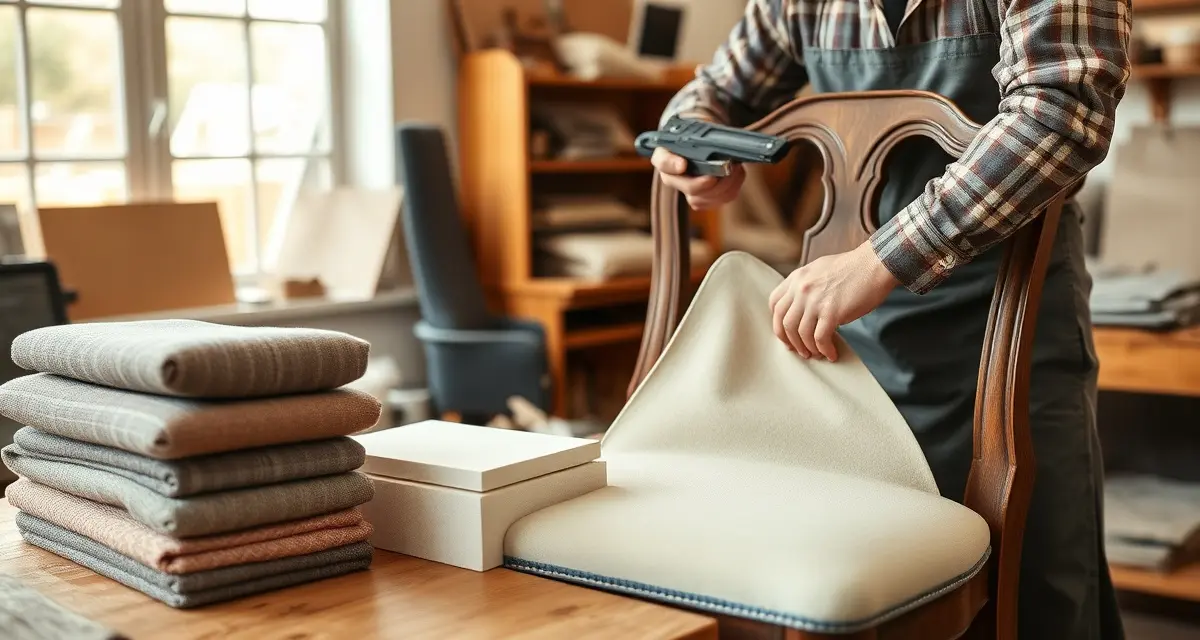
The most common chair job is replacing the seat pad on dining chairs. The process is straightforward: unscrew the seat pad from the chair frame, strip the old fabric and foam, replace foam as needed, apply Dacron, cut new fabric, and staple.
For dining chairs with both seat and back upholstery, photograph the back before disassembly to document how the fabric was attached. Chair backs vary significantly: some have fabric stapled to a sub-frame that removes from the main frame, others are stapled directly to the back rail.
For a set of dining chairs, cut all seat pieces and all back pieces at the same time from the same fabric to ensure consistent grain direction and appearance across the set.
Fully Upholstered Chair Reupholstery
Wingback, club, barrel, and fully upholstered lounge chairs require careful disassembly documentation. Photograph all sides before stripping. Note the sequence in which panels were originally installed, since reinstallation requires the reverse sequence: outside panels go on last.
The typical sequence for a fully upholstered chair is:
- Disassemble and document
- Frame inspection and repairs
- Replace webbing or spring base as needed
- Install new foam and batting
- Install inside arms
- Install inside back
- Install seat
- Install outside arms
- Install outside back
- Add welt, finish edges
- Add cambric dust cover
Welt (also called piping or cord) is often what distinguishes a professional result from a home job. Cut welt on the bias for more flexibility on curves, or straight grain for geometric edges. Match welt fabric to the main fabric unless contrasting welt is specified.
Foam Specifications for Chairs
Seat cushions and tight-seat chair pads: 2.0 lb/ft3 density, 35-40 ILD, 3-4 inches thick.
Back cushions: 1.5-1.8 lb/ft3 density, 18-25 ILD for softness, 3-4 inches thick.
Inside arm padding: thin polyester batting or 1/2-inch low-density foam is typically sufficient. Arms do not bear weight and do not need structural foam.
Setting Customer Expectations
Chair reupholstery takes 3-8 hours of labor depending on the chair type and complexity. Be specific in your quote about what is included: does it include new foam? New webbing if needed? Welt replacement? A customer who receives a chair with all-new internals and clean professional welting should know they are getting that value, not just "recovered fabric."
Use StitchDesk to build line-item quotes that show each element: labor, fabric, foam, webbing, welt, and any frame repairs. This transparency builds trust and makes pricing discussions clearer.
For managing multiple chair sets alongside other shop work, see the shop lead time guide for scheduling strategies that keep chair jobs from bottlenecking larger productions.