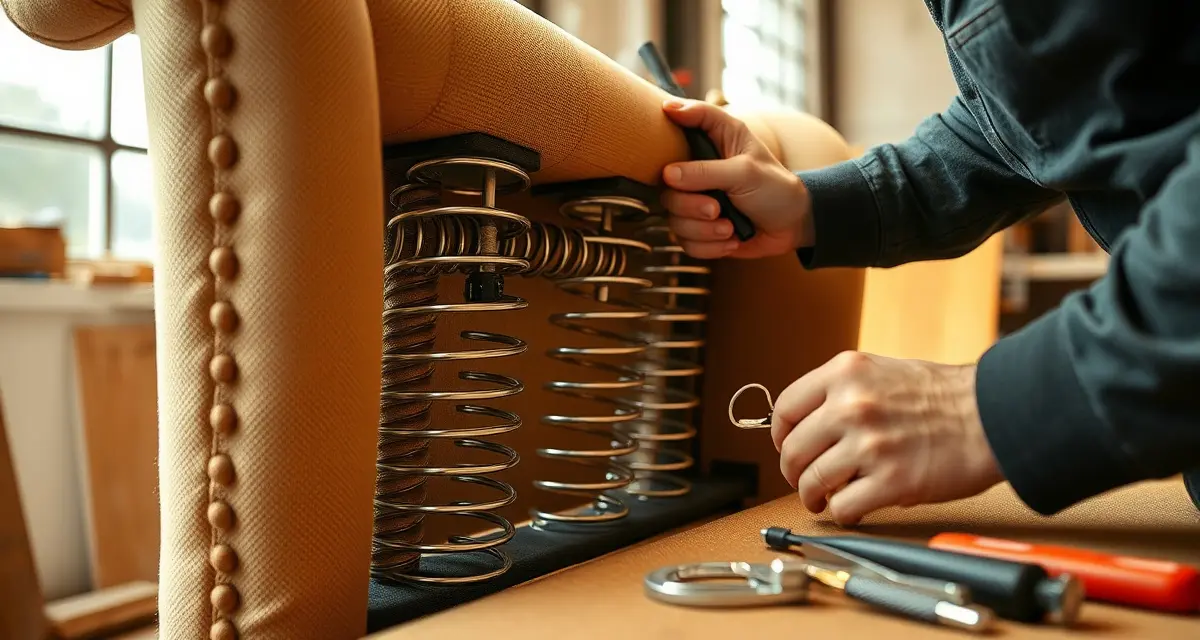
Upholstery Shop Spring Repair Guide
Spring repair is a significant portion of the structural work that upholstery shops perform as part of reupholstery projects. A piece that looks fine from the outside may have a spring system in failure. Identifying this during the frame inspection and quoting the repair correctly prevents mid-job surprises and ensures the finished piece gives the customer the support they expect.
Types of Spring Systems in Upholstered Furniture
Eight-way hand-tied coil springs: the traditional spring system in high-quality furniture. Individual coil springs are placed on a jute or fabric webbing base, attached to the base with hog rings or ties, and then tied with twine in eight directions (front to back, side to side, and both diagonals). This system, when properly tied, provides excellent support and longevity. It is also the most labor-intensive to repair.
Sinuous (no-sag) springs: S-shaped wire springs attached to the front and back seat rails. They run front to back in parallel rows and are connected side to side with small metal clips. The most common spring system in mid-to-high-range residential furniture built after 1970. Faster to install and repair than coil springs, with good durability.
Flat spring bases: similar in principle to sinuous springs but with a different profile. Common in some European furniture designs and in commercial seating.
Webbing only (no springs): some furniture, particularly lighter residential chairs and bench seats, uses stretched webbing (jute or polypropylene) as the only seat support, with no springs. This is appropriate for lighter-duty applications and is very simple to replace.
Diagnosing Spring Problems
Coil spring problems:
- Broken coil: a broken coil creates a low point in the seat surface. Visible as a flat or concave area when sitting; audible as a metallic creak or clunk.
- Broken or missing ties: individual tie cords break over time, allowing springs to lean or move. Causes uneven seat height and may allow a spring coil to contact the seat fabric from below.
- Spring detachment from base: hog rings that hold springs to the webbing base fail, allowing springs to move laterally.
Sinuous spring problems:
- Detached end: the most common sinuous spring failure. The end clip or tack strip attachment fails, freeing one end of the spring. The spring then sags or lifts irregularly. Audible as a popping or creaking when weight is applied to the seat.
- Broken spring: less common than detachment. The wire breaks, typically at the attachment point or at a clip location.
- Stretched or deformed spring: extreme overloading can permanently deform sinuous spring curves, reducing their support capacity.
Webbing problems:
- Sagged or stretched webbing: webbing under insufficient tension or that has stretched with age creates a soft, low seat base. The seat compresses excessively and may bottom out.
- Broken webbing: a strip pulls free from the tack or staple attachment, creating a gap in the seat support base.
Inspection Method
Strip the dust cover from the underside of the piece. This single step gives you direct visual access to the spring or webbing system without disassembling any fabric.
For coil spring systems: check all tie cords. Tug each cord firmly. A properly tied cord should have slight give but should not move the spring significantly or allow it to lean. Check the base webbing for sagging or breakage.
For sinuous springs: check each spring end. Push down on the seat and look for movement at the attachment points. A detached end will be visible as a spring end that lifts free from the rail when the seat is depressed.
For webbing: push down on the seat from above with one hand through the stripped underside. The webbing should be firm with minimal deflection before you feel the frame rails. Excessive deflection indicates sagged or broken webbing.
Repair Techniques
Coil spring retying: remove all broken tie cords. Replace with new spring twine. Tie in all eight directions, starting from the center spring and working outward, maintaining even spring height across the spring field.
Sinuous spring reattachment: pry out the failed clip or tack. Rehook the spring end using a replacement clip or tack. Verify that the spring tension matches adjacent springs; adjust the clip position if needed.
Webbing replacement: remove all old webbing completely (staples and tacks). Reweave new webbing strips in a tight interlaced pattern, stretching each strip firmly before stapling. For traditional jute webbing, use a webbing stretcher tool for proper tension.
Documentation and Quoting
Document spring system findings on the work order during the frame inspection. Photograph the spring system from below before any repair work.
Include spring repair as a separate line item on the quote. Do not bundle it into a generic labor total; the customer should know they are paying for structural repair that extends the life of the piece.
Spring repair adds 2-6 hours to a typical job depending on the system type and the extent of repair needed. Eight-way hand-tied retying on a large sofa is the most time-intensive; simple sinuous spring end reattachment may take under an hour.
StitchDesk's job records allow you to document frame findings and attach spring repair work as a separate scope item. See the frame inspection guide for the complete pre-upholstery inspection process, and the chair reupholstery guide for how spring assessment fits into the overall chair job workflow.