Headboard Reupholstery Guide
Headboards are a strong category for upholstery shops because the market for custom upholstered headboards is substantial and the work is generally straightforward. A customer who wants a specific fabric for their bedroom headboard has usually already spent time selecting that fabric, is invested in the project, and is a candidate for additional upholstery work on matching bedroom pieces.
Types of Upholstered Headboards
Panel headboards are flat or slightly padded panels that attach to the bed frame. The simplest construction: plywood sub-frame, foam, batting, fabric. Typical thickness is 2-3 inches of foam. Mounting hardware attaches to the bed frame or wall-mounts directly.
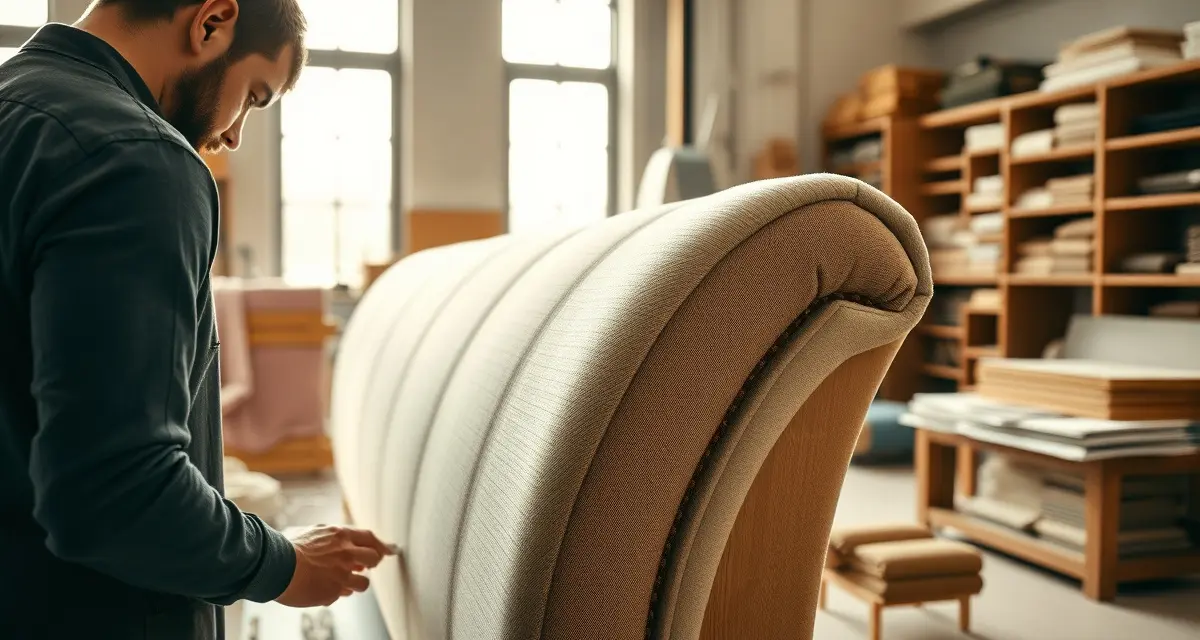
Channel-tufted headboards have vertical channels of foam with the fabric tufted into grooves between channels. The channels are typically routed or cut into the foam. This construction requires precise foam cutting and careful fabric installation to maintain clean channel lines.
Button-tufted headboards use through-foam buttons to create the diamond or grid tufting pattern. The button placement must be marked precisely on the fabric and foam before assembly. The tufting needle pulls button twine through the foam and fabric to the back of the panel.
Wingback or shaped headboards have a shaped profile rather than a simple rectangle. The profile may include curved top edges, side wings, or layered panels. These require custom fabric cutting patterns that follow the profile shape.
Fabric and Foam for Headboards
Headboards are lower-use applications than seating. They do not receive the abrasion and compression load of seat cushions, so foam density requirements are more relaxed.
Foam specification:
- Standard padded headboard: 1.5-2.0 lb/ft3 density, ILD 28-36, 2-3 inch thickness
- Button-tufted headboard: slightly firmer foam at ILD 35-40 holds tufting definition better
- Channel-tufted headboard: firmer foam at ILD 40-45 for clean channel edge definition
Apply one layer of Dacron batting over the foam before covering. Dacron softens the foam edges, which would otherwise show as visible ridges through the fabric, and adds a slightly fuller, softer appearance.
Fabric considerations: headboards are display surfaces where appearance is the primary performance requirement. This opens the full range of fabric types: velvet, boucle, chenille, linen, cotton, performance fabric, and leather or faux leather are all appropriate. For headboards in rooms with direct sun exposure, warn customers about fading on natural fabrics. For headboards in children's rooms, specify a performance or wipeable fabric.
Fabric Yardage for Headboards
Headboard yardage depends on the bed size and headboard height.
Typical finished headboard dimensions:
- Twin: 38-42 inches wide x 40-48 inches tall
- Full: 54-58 inches wide x 40-52 inches tall
- Queen: 62-66 inches wide x 42-56 inches tall
- King: 78-82 inches wide x 42-60 inches tall
For a plain fabric on a queen headboard at 64 x 52 inches: the face fabric requires approximately 64 x 52 inches plus wrap-around allowance of 8-10 inches per side. Total cut size approximately 84 x 72 inches, which is just over 2 yards of 54-inch fabric (requiring a seam at center), or from 60-inch fabric in one piece.
For button-tufted headboards, add 15-20% to the base yardage to account for the fabric pulled into the tufting grooves.
For tall wingback headboards over 60 inches, calculate whether a seam will be required and whether the seam placement is acceptable to the customer. Centered seams on headboards are less visible than off-center seams but are still visible on solid fabrics.
Installation Process
- Photograph the existing headboard from all angles before stripping.
- Remove any existing fabric and batting. Remove every staple completely.
- Inspect the backing panel for damage, cracks, or irregularities.
- Apply new foam to the backing panel with spray adhesive.
- Apply Dacron batting over foam, wrapping edges to the back side.
- For button-tufting: mark button placement on both foam and fabric before assembly.
- Center fabric over the padded panel. Pull taut to the back, stapling at 2-inch intervals, starting from the center of each edge and working outward.
- Create neat hospital corners or mitered corners at each corner.
- For button-tufting: pull buttons through using the tufting needle with consistent tension.
- Cover the back with backing fabric or cambric.
- Attach or reattach mounting hardware.
Common Headboard Mistakes
Insufficient wrap-around on the sides: the fabric must extend fully around the foam edge and attach firmly to the back. Insufficient wrap creates visible thinning at the foam edge from the front.
Uneven button placement: button-tufted headboards require careful measurement and marking before assembly. Eyeballing the placement produces irregular tufting that is immediately visible.
Not testing button tension consistency: buttons pulled to different depths produce an irregular surface. Develop a consistent technique and test on a scrap before working on the actual headboard.
Use StitchDesk to quote headboard jobs with line-item detail on foam, batting, fabric, labor, and hardware. See the fabric yardage calculator for yardage estimates by headboard size, and the upholstery shop revenue guide for how headboard work fits into a balanced shop revenue mix.